
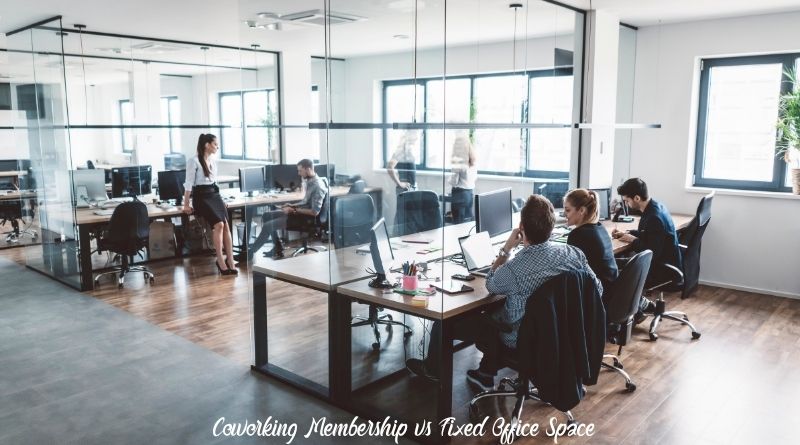
Flexible Coworking Membership vs Fixed Office Space: What to Choose?
The way we work has changed permanently. Where once the default was a signed lease, a dedicated desk, and a five-year commitment, today’s businesses, from solo consultants to growing teams of twenty, are asking a more fundamental question: does a fixed office actually serve us, or have we just inherited the assumption that it should?
The rise of the coworking space membership has given that question real teeth. But flexible is not always better, and fixed is not always wasteful. The right answer depends on where your business actually is; it’s not where conventional wisdom thinks it should be.
The Case for a Coworking Space Membership
A coworking space membership is not simply a desk you rent by the month. Done well, it is a flexible infrastructure layer for your business – one that scales with you rather than ahead of you.
Cost without commitment:
A traditional office lease locks you into a fixed overhead regardless of how the business performs. A membership, by contrast, is a variable cost you can adjust. Scaling up a team? Add desks. Quiet period? Step down a tier. That flexibility has real financial value, particularly for businesses in growth phases where headcount can shift quickly.
Location as a tool, not a constraint:
Many coworking memberships give access to multiple sites across a city or even nationally. For teams with clients in different areas, or employees who do not all commute from the same direction, this matters. The office comes to the work rather than the other way around.
Community and serendipity:
This is consistently underrated. Shared coworking environments place you alongside other founders, freelancers, and operators. The informal conversations, referrals, and collaborations that emerge from that proximity are genuinely difficult to replicate in an isolated private office.
No facilities burden:
Maintenance, utilities, cleaning, broadband, meeting room booking – these are handled. For a small team, the administrative overhead of running a traditional office is not trivial. A membership removes it entirely.
The Case for Fixed Office Space
Fixed office space has not become irrelevant. For the right business at the right stage, it remains the stronger choice.
Culture requires a home:
If you are building a team with a distinct identity, rituals, and a particular way of working together, a shared coworking floor is not neutral. It is subtly disruptive. Fixed space lets you design the environment to reflect your values: the layout, the branding, the atmosphere. That is not vanity; it is operational.
Confidentiality and focus:
Certain industries that are legal, financial, healthcare-adjacent, operate under confidentiality requirements that coworking environments do not easily accommodate. Beyond compliance, some work simply demands quiet, controlled environments that hot-desking floors cannot reliably provide.
Predictability at scale:
Once a team reaches a consistent size (typically above fifteen to twenty people), the per-head cost of a coworking membership often exceeds a comparable leased office. Fixed space becomes more cost-efficient, not less, when headcount stabilises.
Client perception:
For businesses where the physical meeting environment shapes how clients perceive you, a branded reception and a dedicated boardroom signal permanence and seriousness in a way that a shared lobby does not.
The Questions That Actually Decide It
Rather than choosing based on trend or assumption, run your decision through these:
How stable is your headcount over the next eighteen months?
If you genuinely do not know, flexibility has a premium worth paying.
Does your work require confidentiality or deep focus at scale?
If yes, a private fixed space is likely necessary regardless of cost.
Are you in a growth phase or a maturity phase?
Early-stage businesses benefit from not over-committing. Established businesses often benefit from the discipline and identity of a permanent home.
What does your team actually want?
Hybrid and remote preferences have reshaped this calculus. A fixed office that sits half-empty most days is a poor use of capital by any measure.
The Honest Answer
For most businesses under fifteen people, or those navigating growth or uncertainty, a coworking space membership will outperform a fixed lease on almost every dimension: cost, flexibility, location options, and community access.
For established teams with stable headcount, confidentiality requirements, or a strong need for cultural identity, fixed space earns its cost.
The worst outcome is defaulting to either without examining the assumption. The office, whether fixed or flexible, should serve the work. Not the other way around.
If you are ready to explore what flexible working can genuinely look like, The Varo is worth a serious look. With membership options designed around how modern businesses actually operates , The Varo offers the professional environment, community, and flexibility that growing teams need without the burden of a long-term lease. Whether you need a hot desk for a day or a dedicated space for your whole team, it is the kind of place that meets you where you are and grows with you as you scale.